
by Sridevi Srinivasan
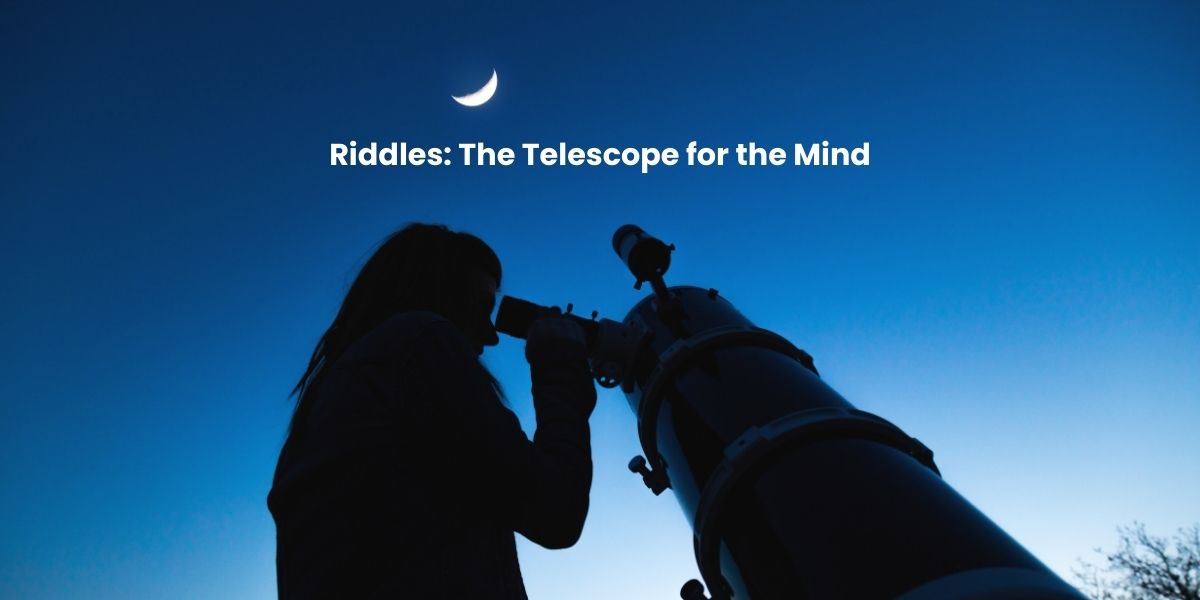
A small lens that allows you to see the world differently, closer, clearer, and sometimes even better than being in that place. Isn’t that amazing? We all know that this small but powerful lens is found in a telescope.
So why am I writing about a telescope?
What am I really trying to say?
Let me begin with a few riddles.
The more you take away, the bigger it gets. What is it?
What goes up but never comes down?
Did you figure out the answers?
The more you take away, the bigger it gets—it’s a hole.
What goes up but never comes down—your age.
These riddles may look simple, but they make us pause and think. And that is exactly their power.
Riddles are like the lenses in a telescope. They help us look at ordinary ideas from a different perspective. When a child reads the first riddle, they must think logically and understand how taking something away can actually make a hole bigger.
And in the second riddle, when they think about age, they realise that some things only move forward.
This kind of thinking does not come from memorising answers. It comes from reflecting on words and meanings.
Basically, riddles are a workout for the brain. They encourage children to think through language, connect ideas, and understand concepts beyond what is written. Learning happens naturally, without pressure.
Just like a telescope brings distant objects into focus, riddles bring clarity to thinking. These short sentences hold immense power, they nurture logical thinking, reasoning, and comprehension.
For young learners, riddles are one of the best learning tools. Reading, understanding, and answering riddles strengthens reading skills and improves comprehension. Tricky riddles challenge the brain to think above and beyond. They kindle curiosity and create a genuine interest in learning.
Most importantly, when a child answers a riddle, it builds confidence. The joy of finding the answer is empowering.
A child who may seem dull or slow often does not lack ability, they lack opportunities to think. When such children are exposed to riddles consistently, thinking becomes a habit. Slowly, they learn to question, analyse and express their thoughts.
As parents and educators, we often focus on teaching children what to think. Riddles gently teach them how to think.
You don’t need worksheets or long lessons. A simple riddle a day, at home or in the classroom can make a big difference. Let children think aloud. Let them struggle a little. That struggle is where learning begins.
Give children riddles, and you don’t just give them answers.
You give them a telescope for the mind.
Here are few riddles for young learners.
1. Riddle: It belongs to you, but your friends use it more often. What is it?
Answer: Your name.
2. Riddle: What weighs more? A KG of chocolate or a KG of feathers?
Answer: They both weigh the same—1 KG each.
3. Riddle: Arun’s mother has three children: Sujith, Ram, and _____?
Answer: Arun.
4. Riddle: What has legs, but doesn’t walk?
Answer: A table.
5. Riddle: What goes away as soon as you mention it?
Answer: Silence.
6. Riddle: What can you hear, but not see or touch, even though you control it?
Answer: Your voice.
7. Riddle: What number is odd, until you take away one letter and it becomes even?
Answer: Seven.
8. Riddle: A railroad crossing has many cars, but can you spell that without any Rs?
Answer: T – H – A – T.
9. Riddle: What has many eyes, but can’t see?
Answer: A potato.
10. Riddle: How many sides does a circle have?
Answer: 2, inside and outside
11. Riddle: What is orange, has a green top, and sounds like a parrot?
Answer: A carrot!
12. Riddle: Imagine that you are in a room without any doors or windows. How would you get out?
Answer: Stop imagining.
13. Riddle: What goes up but never comes down?
Answer: Your age.
14. Riddle: What gets wet while drying?
Answer: A towel.
15. Riddle: What has a thousand needles but doesn’t sew?
Answer: A porcupine.
16. Riddle: I’ve got a slender body but just one eye. No matter what happens, I never cry. What am I?
Answer: A needle.
17. Riddle: What runs but cannot walk, has a mouth but no teeth, and has a bed but cannot sleep?
Answer: A river.
18. Riddle: What has a bottom at the top?
Answer: Your legs.
19. Riddle: What asks no questions but requires many answers?
Answer: A doorbell.
20. Riddle: What is frequently served but should never be eaten?
Answer: A tennis ball.
21. Riddle: If five cats can catch five mice in five minutes, how long will it take a cat to catch one mouse?
Answer: Five minutes.
22. Riddle: What has hands but cannot hold a thing?
Answer: A clock
23. Riddle: A rooster is sitting on top of an A-frame barn. Why aren’t eggs rolling off the roof?
Answer: Roosters don’t lay eggs.
24. Riddle: What can you put in your pocket that would leave it empty?
Answer: A hole
25. Riddle: I sometimes run, but cannot walk. You follow me around. What am I?
Answer: Your nose.
26. Riddle: What type of car is spelled the same backward and forward?
Answer: Racecar.
27. Riddle: What can travel around the world without leaving its corner?
Answer: A postage stamp.
28. Riddle: A girl fell off a 20-foot ladder. She wasn’t hurt. Why?
Answer: She fell off the bottom step
29. Riddle: What do you get when you cross an automobile with a household animal?
Answer: A carpet!
30. Riddle: What has a powerful horn, but doesn’t make any noise?
Answer: A rhinoceros.
31. Riddle: I am made of water, but I’m not wet. What am I?
Answer: A cloud.
32. Riddle: I run around town all day and night, but never get tired. What am I?
Answer: A road.
33. Riddle: What is as big as a hippo but weighs nothing at all?
Answer: A hippo’s shadow.
34. Riddle: You can hear me, but can’t see me, and I won’t answer unless spoken to. What am I?
Answer: An echo.
35. Riddle: What three numbers have the same answer when added together and multiplied together?
Answer: 1, 2, and 3.
36. Riddle: You see me once in June, twice in November, but not at all in May. What am I?
Answer: The letter e.
37. Riddle: What has 88 keys, but cannot open a single door?
Answer: A piano.
38. Riddle: Where can you find cities, towns, shops, and streets but no people?
Answer: A map.
39. Riddle: I shave several times a day, but my beard stays exactly the same. How?
Answer: I’m a barber!
40. Riddle: What keeps going up and down but never moves?
Answer: A staircase.
41. Riddle: What has to be broken before it can be used?
Answer: An egg.
42. Riddle: What month of the year has 28 days?
Answer: All of them!
43. Riddle: What can you keep after giving it to someone?
Answer: Your word.
44. Riddle: Three doctors said that Bill was their brother, but Bill has no brothers. How?
Answer: The doctors were Bill’s sisters.
45. Riddle: What can be caught, but not thrown?
Answer: A cold.
46. Riddle: What has lots of teeth, but doesn’t bite?
Answer: A comb.
47. Riddle: If there are three apples and you take away two, how many apples do you have?
Answer: Two.
48. Riddle: What kind of band never plays any music?
Answer: A rubber band.
50: Riddle: What has one head, one foot, and four legs?
Answer: A bed.
49. Riddle: What has many ears but can’t hear a thing?
Answer: A cornfield.