Send a message.
We’re here to answer any question you may have.
Would you like to join our growing team?
littlelaudablelearners@gmail.com


Did you know that an audience decides whether you are a powerful speaker within the first 30 seconds of your speech?
Imagine standing on a stage with thousands of people, all eyes on you.
Can you mesmerise them completely?
Can you command silence—every eye focused, every ear tuned in?
In those first few moments, all you truly have is your presence, your voice, and a compelling hook—one that grabs attention instantly.
You may have an impactful story, vivid imagery, strong ideas, and meaningful experiences to share. But if you fail to connect with your audience in the first 30 seconds, the speech often feels incomplete.
That is where the hook matters.
A powerful hook is the foundation of a great speech. It helps you build an immediate connection—strong enough to hold attention and allow the audience to imagine, feel, and experience your words.
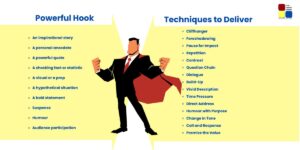
A hook does not have to be complicated. It can be:
But here’s the real question:
If you include any one of these, can you be sure your speech will hold the audience for the next few minutes?
Not necessarily.
The power of a hook lies not just in what you choose, but in how you present it.
Delivery matters—tonality, voice modulation, pauses, intonation, body language, and preparation all play a crucial role.
Let’s look at techniques that can turn a simple hook into a powerful one.
1. Cliffhanger
Pause at an exciting moment so the audience wants more.
Example:
“I opened the box… and what I saw inside made me stop. Completely.”
2. Foreshadowing
Hint that something important is coming.
Example:
“That one moment changed the way I think—even today.”
3. Pause for Impact
Silence can be more powerful than words.
Example:
“I was completely unprepared.
…Or so I thought.”
4. Repetition
Repeat to reinforce and create rhythm.
Example:
“I tried once. I tried again. I tried one more time.”
5. Contrast
Juxtapose two opposing ideas.
Example:
“I looked confident on the outside, but inside I was terrified.”
6. Question Chain
Pull the audience deeper with connected questions.
Example:
“What would you do?
Would you give up—or try again?”
7. Dialogue
Bring the moment alive with spoken words.
Example:
“‘You will be fine,’ my teacher said.”
8. Build-Up
Start simple and increase emotional intensity.
Example:
“At first, it seemed like a normal day.
Then everything changed.”
9. Vivid Description
Paint a picture using sensory details.
Example:
“The room was silent. I could hear my own breathing.”
10. Time Pressure
Create urgency.
Example:
“I had only ten seconds to decide.”
11. Direct Address
Speak directly to your audience.
Example:
“Think about the last time you felt nervous.”
12. Humour with Purpose
Light humour that supports your message.
Example:
“I was confident—until I saw the microphone.”
13. Change in Tone
Shift vocal energy to surprise listeners.
Example:
“I was calm.
Then everything changed.”
14. Call and Response
Invite participation.
Example:
“Raise your hand if this has happened to you.”
15. Promise the Value
Tell them what they will gain.
Example:
“By the end of this speech, you will see this differently.”
A hook is like opening an electric circuit and leaving it incomplete.
The circuit stays open in the mind of the audience. They think, wonder, and listen closely—waiting for you to close it.
A skilled speaker chooses when to close that circuit—at the very end, or just before the call to action.
At Raising Confident Communicators, children learn how to craft compelling speeches through guidance, worksheets, practice, and opportunities to showcase their skills. Along with public speaking, they develop creative writing, storytelling, grammar, and reading—making communication learning a truly wholesome experience. If you’d like to know more, do reach out.