The Magic of Puppets: Strengthening Storytelling and Public Speaking Skills in Kids

The Magic of Puppets in Storytelling: Helping Young Learners Find Their Voice
Sara was a quiet girl. She always remained silent in her class. Whenever she came to the front of the classroom, she felt scared.
This girl could speak well. Her voice was bright. But she had a deep fear of facing everyone.
Her teacher wanted to help her overcome that fear. She tried various methods. One day, she asked Sara to present a short story in front of the class.
Sara was ready to learn the story. But she had two problems.
She kept forgetting the flow of the story.
She could not let go of her fear of facing everyone.
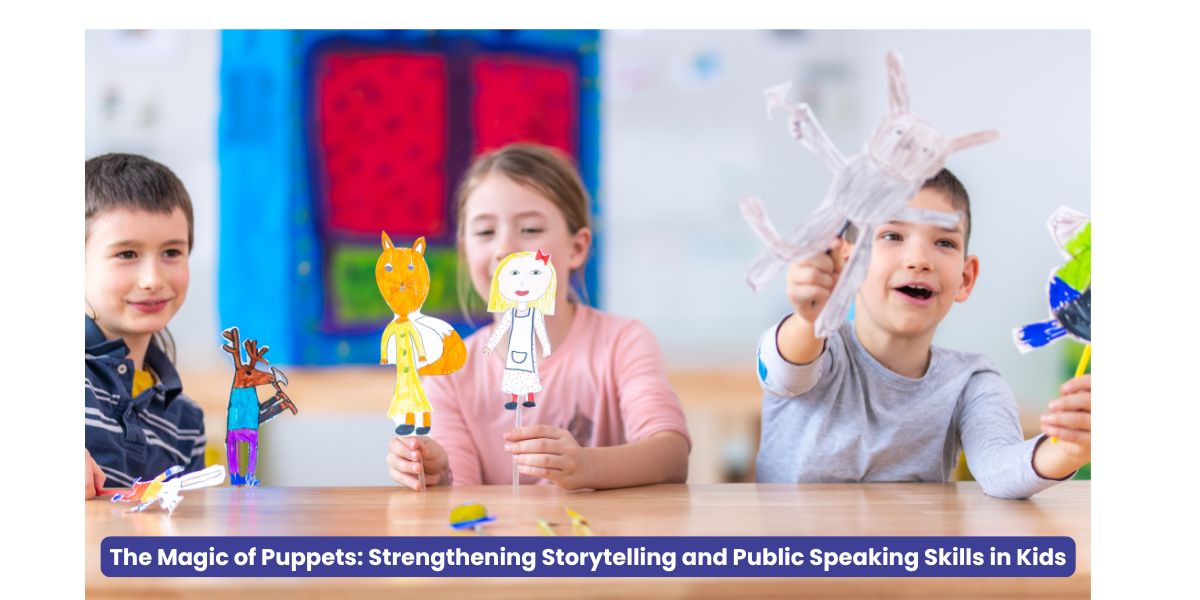
That was when the teacher came up with a beautiful idea, puppets to suit the characters of the story.
Now Sara held the puppets in her hands. She focused on which puppet to hold next instead of thinking about her fear. She could remember the flow of the story easily because each puppet reminded her of the next part.
Along with that, Sara gave different voices to different puppets and made the storytelling presentation truly interesting.
Dear friends,
In my experience, I have seen many students like Sara. Storytelling with this beautiful aid called a puppet brings magic to a storytelling presentation. It not only entertains the audience and helps them understand the story better, but it also gives immense benefits to the storyteller, helping them remember the flow, experiment with voices, and overcome the fear of standing in front of everyone.
Puppets Are More Than Just Props
Puppets are amazing tools. If used well in storytelling presentations, they become magical , both for the teller and the listener.
Instead of imagining a lion in their head, children see it in their hands. The story becomes visible.
Cognitive psychologist Jerome Bruner emphasized that children understand the world through narratives. Puppets help children organize stories clearly into:
- Beginning
- Problem
- Solution
- Moral
When children move characters in sequence, they are not merely memorising , they are constructing meaning.
Puppets Reduce Stage Fear
One of the biggest challenges in storytelling is nervousness.
Psychologist Lev Vygotsky highlighted the importance of imaginative play in learning. When children speak through a puppet, they experience what educators call psychological safety.
Instead of thinking:
“I am speaking.”
It becomes:
“My puppet is speaking.”
The pressure shifts. Confidence rises.
We have seen shy children speak louder, smile more, and even experiment with voice modulation when they hold a puppet. The puppet becomes their confidence partner.
How We Use Puppets in Our Young Learner Courses
In our courses for young learners, puppets are not just play materials , they are structured learning tools designed to build literacy and communication skills.
Here is how we integrate them:
1️⃣ Story Sequencing Practice
Children use different puppets for different characters. This helps them remember the flow of the story naturally , first, next, then, and finally.
2️⃣ Vocabulary Expansion
Each puppet introduces new descriptive words. A brave tiger. A clever crow. A gentle grandmother. Language becomes richer and more expressive.
3️⃣ Voice and Expression Training
Children learn:
- Voice modulation
- Dialogue delivery
- Character emotions
- Clear articulation
This builds strong public speaking foundations from an early age.
4️⃣ Confidence Without Pressure
Our small group structure ensures that children feel safe. The focus remains on growth, not performance anxiety. Children learn joyfully, without the fear of being judged.
Beyond Storytelling , Building Life Skills
Puppet storytelling strengthens:
✔ Reading comprehension
✔ Sequencing skills
✔ Critical thinking
✔ Emotional expression
✔ Focus and attention
✔ Public speaking confidence
When a child controls a puppet, they control the story.
And when they control the story, they begin to control their voice.
A Small Puppet, A Big Transformation
In a world where communication skills matter more than ever, we believe confidence should begin early , gently, joyfully, and playfully.
Sometimes, all it takes is a little puppet…
…to help a young learner discover a powerful voice.